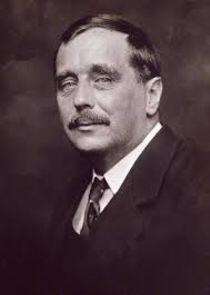
H.G. Wells
In addition to his fame as a writer, he was prominent in his lifetime as a forward-looking, even prophetic social critic who devoted his literary talents to the development of a progressive vision on a global scale. As a futurist, he wrote a number of utopian works and foresaw the advent of aircraft, tanks, space travel, nuclear weapons, satellite television and something resembling the World Wide Web. His science fiction imagined time travel, alien invasion, invisibility, and biological engineering before these subjects were common in the genre. Brian Aldiss referred to Wells as the "Shakespeare of science fiction", while Charles Fort called him a "wild talent".
Wells rendered his works convincing by instilling commonplace detail alongside a single extraordinary assumption per work – dubbed "Wells's law" – leading Joseph Conrad to hail him in 1898 with "O Realist of the Fantastic!". His most notable science fiction works include The Time Machine (1895), which was his first novella, The Island of Doctor Moreau (1896), The Invisible Man (1897), The War of the Worlds (1898), the military science fiction The War in the Air (1907), and the dystopian When the Sleeper Wakes (1910). Novels of social realism such as Kipps (1905) and The History of Mr Polly (1910), which describe lower-middle-class English life, led to the suggestion that he was a worthy successor to Charles Dickens, but Wells described a range of social strata and even attempted, in Tono-Bungay (1909), a diagnosis of English society as a whole. Wells was nominated for the Nobel Prize in Literature four times.
Wells's earliest specialised training was in biology, and his thinking on ethical matters took place in a Darwinian context. He was also an outspoken socialist from a young age, often (but not always, as at the beginning of the First World War) sympathising with pacifist views. For much of his adult life he was a passionate advocate of eugenics and involuntary euthanasia, arguing in favour of the "sterilisation of failure" as a necessary condition for socialism to succeed, a view he had largely recanted by 1940. In his later years, he wrote less fiction and more works expounding his political and social views, sometimes giving his profession as that of journalist. Wells was a diabetic and co-founded the charity The Diabetic Association (Diabetes UK) in 1934.
Biography from the Wikipedia article H. G. Wells. Licensed under CC-BY-SA. Full list of contributors on Wikipedia.
Part of Crew

Recently Updated Shows

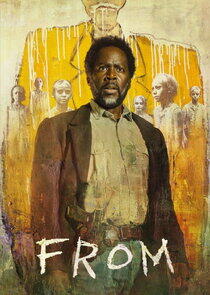
FROM
FROM unravels the mystery of a nightmarish town that traps all those who enter. As the unwilling residents fight to keep a sense of normalcy and search for a way out, they must also survive the threats of the surrounding forest – including the terrifying creatures that come out when the sun goes down. In season two, hidden truths about the nature and terrifying origins of the town begin to emerge, even as life for its residents is plunged into chaos by the arrival of mysterious newcomers.

Brilliant Minds
Inspired by the extraordinary life and work of world-famous author and physician Oliver Sacks, Brilliant Minds follows a revolutionary, larger-than-life neurologist and his team of interns as they explore the last great frontier - the human mind - while grappling with their own relationships and mental health.


For All Mankind
Imagine a world where the global space race never ended. This thrilling "what if" take on history from Ronald D. Moore (Outlander, Battlestar Galactica) spotlights the high-stakes lives of NASA astronauts and their families.