Cold War - Season 1
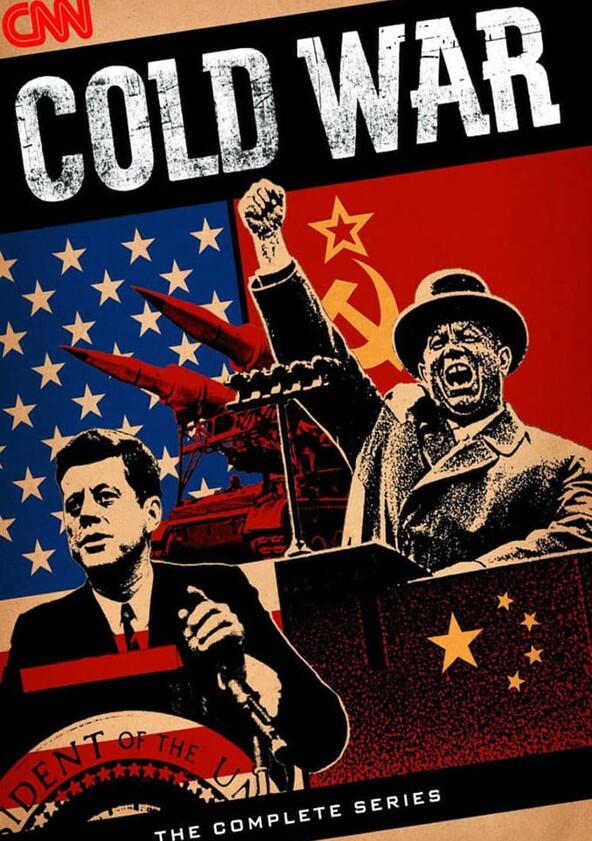
Season 1

Episodes

Comrades (1917-1945)
Once allies against HItler, the Soviet Union and the United States confront each other at the end of World War II. Looming over the postwar landscape is the awesome, mushroom-shaped cloud of the atomic bomb.
Iron Curtain (1945–1947)
In the months following their victory in World War II, the alliance between the Soviet Union and the West quickly proves to be little more than a marriage of convenience. Suspicion clouds relations -- while a curtain descends over Europe.
Marshall Plan (1947–1952)
With hunger and discontent plaguing postwar Europe, the U.S. proposes an aid program to rebuild the ruined continent.
But the Marshall Plan also solidifies the deep ideological differences between East and West.
Berlin (1948–1949)
Three years after the end of World War II, the Nazis' former capital, Berlin, would once again find itself the target of an allied air fleet. This time, the air armada was working to save, rather than destroy, the city.
Korea (1949–1953)
It was one of the few times the Cold War went hot. The conflict on the Korean peninsula claimed millions of lives, and set the stage for the way both sides would view each other for years to come.
Reds (1948–1953)
As the Cold War intensifes, so do fears in the Soviet Union and the United States of outside influences -- prompting massive campaigns to purge the "enemy within."
After Stalin (1953–1956)
In 1953, the death of Soviet dictator Joseph Stalin creates a power vacuum in the Kremlin's leadership. It also unleashes a wave of unrest in Eastern Europe, as some Soviet satellites test the limits of Moscow's tolerance.
Sputnik (1949–1961)
The Soviet atomic bomb gives birth to a new arms race -- which turns into a space race. But any promising technological advances are overshadowed by the threat of long-range nuclear destruction.
The Wall (1958–1963)
For years, West Berlin was an escape route for East Germans seeking to flee communism. But growing Cold War tensions forced the Soviet bloc to erect a deadly blockade across the city -- a Wall that divided Berlin for nearly three decades.
Cuba (1959–1962)
The emergence of a communist government in Cuba heightens Cold War tensions -- and for several terrifying days brings the world to the brink of nuclear war.
Vietnam (1954–1968)
It was a conflict that devastated one nation and divided another. Vietnam brought a new dimension to the Cold War -- and forced the United States to rethink its goals in the superpower rivalry.
MAD (1960–1972)
With Cold War tensions heightening at the start of the 1960s, the superpowers are drawn into an escalating arms race. The world's safety depends on a nuclear paradox known as "mutual assured destruction."
Make Love Not War (The 60s)
In the 1960s the United States claimed its place as the world's leading defender against communism. But by the end of the decade, the nation was convulsed by dissent, riot, assassination and an increasingly unpopular war.
Red Spring (The 60s)
In the 1960s, as dissent and protest swept through the West, nations of the Warsaw Pact were experimenting with reforms. But hopes for change were crushed by palace coups and, in the case of Czechoslovakia, outright invasion.
China (1949–1972)
The emergence of the People's Republic of China signals a new and dangerous phase in the Cold War. But a split between Moscow and Beijing opens the door for a change in U.S.-Chinese relations
Detente (1969–1975)
By the end of the 1960s, the United States and Soviet Union faced a choice: slow down their Cold War competition -- a process that would be called détente -- or continue an arms race that could end in all-out war.
Good Guys, Bad Guys (1967–1978)
The Cold War takes on a new dimension as the Soviet Union, the United States and their allies become involved in wars between rivals in Africa and the Middle East.
Backyard (1954–1990)
Central America, the Caribbean and South America become the battleground for a test of wills between the United States and the U.S.S.R. -- as the Cold War comes to America's "backyard."
Freeze (1977–1981)
In 1976, Jimmy Carter and Leonid Brezhnev promised to reduce East-West tensions. But within four years those promises turned to anger and mistrust. The Cold War was far from over.
Soldiers of God (1975–1988)
For centuries, nations had tried to conquer Afghanistan. None succeeded. But the Cold War -- and an Afghan civil war -- would bring a terrible toll of death and destruction to the people of this traditionally Islamic land.
Spies (1944–1994)
The Cold War was fought on two fronts. In public, it was a series of confrontations and crises. But the East and West also battled in the shadows, as intelligence agents risked their lives to steal secrets.
Star Wars (1981–1988)
In 1981, Ronald Reagan -- a strident Cold Warrior -- enters the White House on a platform of "making America strong again." Convinced the United States is lagging in the arms race, Reagan increases defense spending and proposes a "Star Wars" anti-missile system -- alarming leaders in Moscow.
The Wall Comes Down (1989)
For nearly three decades, the Berlin Wall symbolized the Iron Curtain that separated East from West. But by 1989, the Wall was starting to crumble -- and by the end of the year it would collapse.
Conclusions (1989–1991)
It is the twilight of the Soviet empire. With the fall of the Berlin Wall, the Kremlin loses its iron-fisted grip on Eastern Europe. As events spiral out of control, Mikhail Gorbachev finds his authority challenged from within -- both from communist hard-liners, and from a popular reformer named Boris Yeltsin.
Recently Updated Shows

Ancient Aliens
Ancient Aliens explores the controversial theory that extraterrestrials have visited Earth for millions of years. From the age of the dinosaurs to ancient Egypt, from early cave drawings to continued mass sightings in the US, each episode in this hit History series gives historic depth to the questions, speculations, provocative controversies, first-hand accounts and grounded theories surrounding this age old debate. Did intelligent beings from outer space visit Earth thousands of years ago?
The Daily Show
Hosted by a rotating cast of comedy greats, The Daily Show remains the go-to source for provocative satire, insightful interviews and an award-winning team of correspondents and contributors.
Survivor
Eighteen to twenty castaways will compete against each other on Survivor. All castaways will compete to outwit, outplay, outlast and ultimately be crowned Sole Survivor.
Last Week Tonight with John Oliver
On Last Week Tonight with John Oliver, John Oliver presents a satirical look at the week in news, politics and current events.

Saturday Night Live
Saturday Night Live is an Emmy Award-winning late-night comedy showcase.
Since its inception in 1975, "SNL" has launched the careers of many of the brightest comedy performers of their generation. As The New York Times noted on the occasion of the show's Emmy-winning 25th Anniversary special in 1999, "in defiance of both time and show business convention, 'SNL' is still the most pervasive influence on the art of comedy in contemporary culture." At the close of the century, "Saturday Night Live" placed seventh on Entertainment Weekly's list of the Top 100 Entertainers of the past fifty years.