Die Manns - Ein Jahrhundertroman - Season 1

Season 1

Episodes
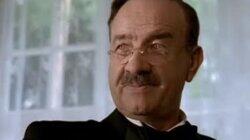
1923 - 1933
Thomas Mann received the Nobel Prize in 1929 for his novel "Buddenbrooks" (1901). While the poet retires to his study every morning, Katia takes care of the children, the household, the manuscripts and her husband's correspondence. They did not return to Germany from a reading tour in February 1933 because they realized that they did not want to live in a country ruled by National Socialists. Thomas Mann's brother Heinrich (1871 - 1950; Jürgen Hentsch), who became famous through his novels "Professor Unrat" (1905) and "Der Untertan" (1914) and openly criticized the National Socialists, moved to Paris around the same time away. He first has to leave the entertainer Nelly Kröger (Veronica Ferres), who has been his lover for some time, behind in Berlin. (He separated from his wife Maria Kanova in 1928.)
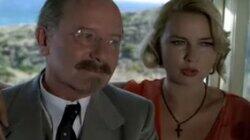
1933 - 1941
Katia and Thomas Mann lived with their younger children first in southern France, then in Switzerland, until they moved to the United States of America in 1938 and from 1942 lived in California. Erika Mann (1905 - 1969; Sophie Rois) became known through the cabaret "Die Pfeffermühle", which she opened together with Therese Giehse (1898 - 1975; Katharina Thalbach) in Zurich. She hates the National Socialists and pesters her indecisive father until he publicly speaks out against the German government for the first time in early 1936. Klaus Mann (1906 - 1949; Sebastian Koch) acquired American citizenship in 1936. He made a name for himself as an author with an anti-fascist exile magazine and the roman à clef "Mephisto" (1936) about his former brother-in-law Gustaf Gründgens (1899 - 1963). He's addicted to heroin. His lover, the American Thomas Quinn Curtiss, persuades him to go to rehab, but when Klaus relapses, Curtiss leaves him. Heinrich Mann, who married Nelly in Nice in 1939, also came to America in 1940 and celebrated his 70th birthday there the following year. Since his books are ignored in the US, he remains financially dependent on his younger brother.
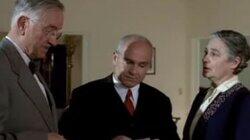
1942 - 1955
Thomas Mann becomes an American citizen in 1943. Nelly Mann remains an outsider in the Mann family and becomes more and more addicted to alcohol. In December 1944 she poisoned herself with pills. Klaus Mann tries to get out of his personal misery by enlisting in the US Army and being assigned to Europe. In 1949, Thomas Mann embarked on his first trip to Europe after World War II with his wife Katia and daughter Erika. Against Erika's resistance, he also visits Germany. Klaus Mann died on May 21, 1949 in Cannes from an overdose of sleeping pills. Heinrich Mann was unexpectedly invited to move to East Berlin as President of the Academy of Arts, but he died on March 12, 1950 – a few days before his planned departure. When the American Senator Joseph Raymond McCarthy (1909 - 1957) organized a hysterical persecution of potential communists and their sympathizers, Katia and Thomas Mann left the USA in 1952 and moved back to Switzerland. Thomas Mann died there on August 12, 1955 at the age of 80.
Recently Updated Shows
True Detective
Touch darkness and darkness touches you back. True Detective centers on troubled cops and the investigations that drive them to the edge. Each season features a new cast and a new case.
True Detective is an American anthology crime drama television series created and written by Nic Pizzolatto.

Shōgun
Shōgun is set in Japan in the year 1600 at the dawn of a century-defining civil war. Lord Yoshii Toranaga is fighting for his life as his enemies on the Council of Regents unite against him, when a mysterious European ship is found marooned in a nearby fishing village.

The Morning Show
Nominated for three Golden Globes®, this unapologetically candid drama looks at the modern workplace through the lens of the people who help America wake up. Pull back the curtain on early morning TV.

The Grand Tour
Jeremy Clarkson, Richard Hammond and James May are back with The Grand Tour. A show about adventure, excitement and friendship... as long as you accept that the people you call friends are also the ones you find extremely annoying. Sometimes it's even a show about cars. Follow them on their global adventure.

Survivor
Eighteen to twenty castaways will compete against each other on Survivor. All castaways will compete to outwit, outplay, outlast and ultimately be crowned Sole Survivor.