Frozen Lands
In the far north of our planet lies the largest land habitat on earth, home to snow-covered forests and the icy open tundra. These are lands of extremes that push animals to their limits: in winter they are so cold that much of the ground has remained frozen since the last ice age. To stand any chance of survival, animals must adapt in extreme ways: here a super pack of wolves, 25 strong, has come together to take on the only large prey available to them in winter, American bison.
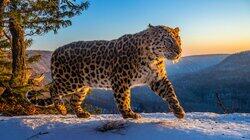
On the featureless tundra, an Arctic fox must strike a living alone. She is a wanderer and will roam many hundreds of miles searching for tiny lemmings, hidden deep underground. The only way to reach them is with a head dive. In the remote far east of Russia, a rare Amur leopard prowls the seemingly empty, snow-covered forest. With little prey available, it must use its ingenuity to find a meal. It follows crows in the hope of finding carrion, but it must not stay long, for it shares the forest with a far larger but equally hungry big cat, the Siberian tiger.
As spring arrives, the forests begin to thaw and life returns. Beneath the ground, a nest of tiny painted turtle hatchlings now emerge, having remained frozen in a state of suspended animation throughout winter. To the north, it is a further month before the sun's warmth baths the frozen ground of the tundra. Tucked away underground lies a tiny snow queen – a Lapland bumble bee. She is the sole survivor of her colony - the rest perished in the winter freeze - but her larger size, her furry body and antifreeze in her blood have allowed her to survive. Now she is in a hurry. She must feed herself and raise a brood in the brief window of summer while the flowers are in bloom.
Snowy owls also use the open tundra to breed: one pair have raised a nest full of fluffy chicks. With 24-daylight in which to hunt, the dedicated parents bring back meal after meal for their ever-growing brood. But one day, they return to find the nest empty…
Today, the biggest challenge in the tundra is climate change. Warming summers are melting the permafrost deep within the soil, causing the ground to thaw and, in places, the land to collapse. These changes are impacting the animals too. Caribou arrive in herds of 200,000 individuals to raise their calves in the rich pastures, but warming means mosquitos emerge sooner and bother the calves before they've had a chance to gain strength. The parents drive their young to cooler, mosquito-free land, but to get there they must cross rivers running with increased meltwater and escape hungry grizzly bears. They, like much of the tundra's wildlife, are adapted to live in the extremes - but the challenge of today's warming climate could be one extreme too many.
Trailer
Recently Updated Shows

Last Week Tonight with John Oliver
On Last Week Tonight with John Oliver, John Oliver presents a satirical look at the week in news, politics and current events.

Lioness
Lioness, inspired by an actual U.S. Military program, follows the life of Joe while she attempts to balance her personal and professional life as the tip of the CIA's spear in the war on terror. The Lioness Program, overseen by Kaitlyn Meade and Donald Westfield, enlists an aggressive Marine Raider named Cruz to operate undercover alongside Joe among the power brokers of State terrorism in the CIA's efforts to thwart the next 9/11.

Doc
Doc centers on the hard-charging, brilliant Dr. Amy Larsen, Chief of Internal and Family Medicine at Westside Hospital in Minneapolis. After a brain injury erases the last eight years of her life, Amy must navigate an unfamiliar world where she has no recollection of patients she's treated, colleagues she's crossed, the soulmate she divorced, the man she now loves and the tragedy that caused her to push everyone away. She can rely only on her estranged 17-year-old daughter, whom she remembers as a 9-year-old, and a handful of devoted friends, as she struggles to continue practicing medicine, despite having lost nearly a decade of knowledge and experience.

Dark Matter
Hailed as one of the best sci-fi novels of the decade, Dark Matter is a story about the road not taken. The series follows Jason Dessen, a physicist, professor, and family man who – one night while walking home on the streets of Chicago – is abducted into an alternate version of his life. Wonder quickly turns to nightmare when he tries to return to his reality amid the multiverse of lives he could have lived. In this labyrinth of mind-bending realities, he embarks on a harrowing journey to get back to his true family and save them from the most terrifying, unbeatable foe imaginable: himself.