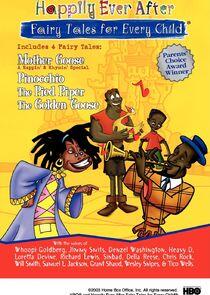
Happily Ever After: Fairy Tales for Every Child (1995-2000)
EndedAnimation showAdventure, Fantasy
Happily Ever After: Fairy Tales for Every Child is an anthology animated series that aired on HBO from 1995-2000. Each episode showcases a classic story in different cultures, which contains characters voiced by various famous celebrities.


Recent Episodes
| Episode | Name | Airdate |
|---|---|---|
| S03E13 | Aesop's Fables | Jul 18, 2000 |
| S03E12 | Robinita Hood | Jun 19, 2000 |
| S03E11 | The Steadfast Tin Soldier | May 16, 2000 |
| S03E10 | The Snow Queen | Apr 18, 2000 |
| S03E09 | Rip Van Winkle | Mar 21, 2000 |
Frequently Asked Questions Warning: Spoilers
When did 'Happily Ever After: Fairy Tales for Every Child' premiere?
'Happily Ever After: Fairy Tales for Every Child' premiered on September 2, 1995.
Who created 'Happily Ever After: Fairy Tales for Every Child'?
'Happily Ever After: Fairy Tales for Every Child' was created by Shelley Duvall.
How many episodes were there in the first season of 'Happily Ever After: Fairy Tales for Every Child'?
The first season of 'Happily Ever After: Fairy Tales for Every Child' consisted of 13 episodes.
Who were some of the guest stars in 'Happily Ever After: Fairy Tales for Every Child'?
Some guest stars in 'Happily Ever After: Fairy Tales for Every Child' included Whoopi Goldberg, Denzel Washington, and James Earl Jones, among others.
What was the premise of 'Happily Ever After: Fairy Tales for Every Child'?
'Happily Ever After: Fairy Tales for Every Child' retold traditional fairy tales with a diverse cast of characters, emphasizing cultural and social issues.
What was the animation style used in 'Happily Ever After: Fairy Tales for Every Child'?
'Happily Ever After: Fairy Tales for Every Child' used a variety of animation styles, including traditional hand-drawn animation, claymation, and computer-generated imagery.
Which fairy tales were adapted in 'Happily Ever After: Fairy Tales for Every Child'?
'Happily Ever After: Fairy Tales for Every Child' adapted various fairy tales, including "The Frog Prince," "Goldilocks and the Three Bears," and "The Princess and the Pea," among others.
How did 'Happily Ever After: Fairy Tales for Every Child' promote diversity?
'Happily Ever After: Fairy Tales for Every Child' promoted diversity by featuring characters from different cultural backgrounds and exploring social issues relevant to those communities.
What was the target audience for 'Happily Ever After: Fairy Tales for Every Child'?
'Happily Ever After: Fairy Tales for Every Child' was aimed at both children and adults, using fairy tales as a means to address important topics in an entertaining way.
Did 'Happily Ever After: Fairy Tales for Every Child' receive any awards or nominations?
Yes, 'Happily Ever After: Fairy Tales for Every Child' received several awards and nominations, including a Peabody Award and multiple Daytime Emmy nominations.
How long were the episodes of 'Happily Ever After: Fairy Tales for Every Child'?
Each episode of 'Happily Ever After: Fairy Tales for Every Child' had a runtime of approximately 30 minutes.
What was the critical reception of 'Happily Ever After: Fairy Tales for Every Child'?
'Happily Ever After: Fairy Tales for Every Child' received positive reviews for its educational value, diverse representation, and creative storytelling.
Did 'Happily Ever After: Fairy Tales for Every Child' have any spin-offs or related shows?
No, 'Happily Ever After: Fairy Tales for Every Child' did not have any spin-offs or related shows.
How did 'Happily Ever After: Fairy Tales for Every Child' contribute to children's television programming?
'Happily Ever After: Fairy Tales for Every Child' was praised for its efforts to introduce children to different cultures, promote tolerance, and encourage empathy.
What was the main goal of 'Happily Ever After: Fairy Tales for Every Child'?
The main goal of 'Happily Ever After: Fairy Tales for Every Child' was to provide children with entertaining and educational programming that fostered inclusivity and cultural understanding.
How did 'Happily Ever After: Fairy Tales for Every Child' impact the animation industry?
'Happily Ever After: Fairy Tales for Every Child' played a significant role in promoting diversity and social awareness within the animation industry, inspiring future creators to follow suit.
Cast
View all cast
Characters
View all characters
Recently Updated Shows
Recently updated shows that might be of your interest.





* This is an affiliate link. If you click and purchase, we will receive a commission from the provider. This will not incur any additional costs for you and you will support our project. We thank you for your support!