Origins of Us - Season 1
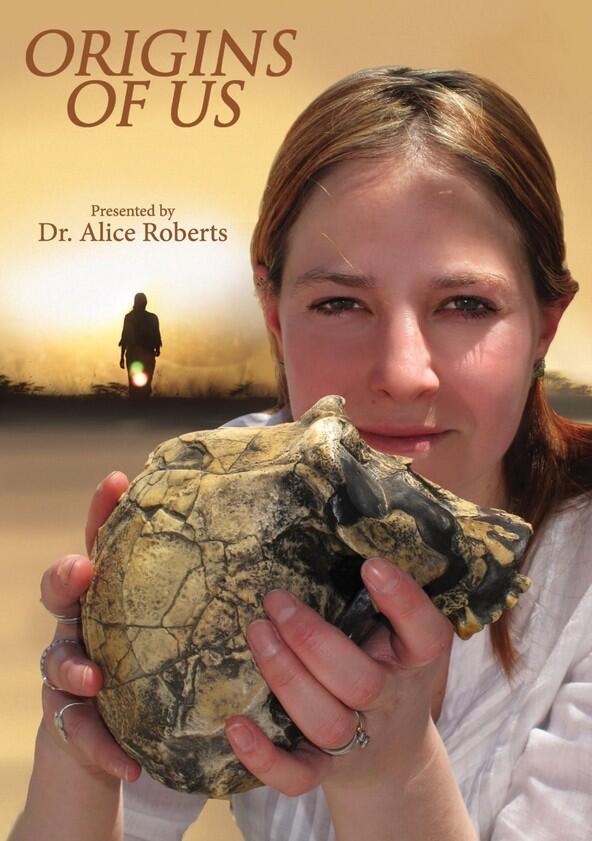
Season 1

Episodes

Bones
In the first episode, Dr Alice Roberts looks at how our skeleton reveals our incredible evolutionary journey.
Trekking through the forests of our ancient ancestors, she goes to meet the apes who still live there today - chimpanzees. In six million years we have become very different, and what kick-started this can be found in an extraordinary fossil - Sahelanthropus. A single hole where the spine was attached suggests that our ancestors started the journey to being human by standing upright. We take it for granted, but standing up and walking is surprisingly complex - each step involves the co-ordination of over 200 muscles.
Charting the major advances from Australopithecus to Homo erectus and beyond, Alice tells the epic story of human evolution through our body today. New research has uncovered clues in our ankles, waists and necks that show how our ancestors were forced to survive on the open plain - by walking and running for their lives. From the neck down we have inherited the body of our ancestor Homo erectus, who lived on the plains of Africa nearly two million years ago.
Finally Alice looks at probably the most important advance in our evolutionary story. A fortuitous by-product of standing up was freeing up our hands. With pressure-sensitive gloves, she demonstrates how the tiniest of anatomical tweaks to our thumbs and little fingers transformed hands that evolved to grasp branches into ones that could use tools. And with our dexterous hands, our species, Homo sapiens, would change the world.
Guts
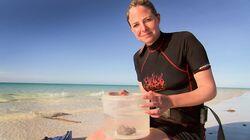
In this second episode Dr Alice Roberts charts how our ancestors' hunt for food has driven the way we look and behave today - from the shape of our face, to the way we see and even the way we attract the opposite sex.
Clues to our ancestors' diet can be found in some surprising places. Alice goes in search of a lion kill to find out how the tape worms in lions' food reveal our ancestors were eating the same diet of big game 1.7 million years ago. She puts her teeth to the test to reveal that our teeth have evolved to shear through meat. But by comparing her saliva with that of chimpanzees, she demonstrates that our body is as much designed to eat starch as it is to eat meat. And visiting a tribe of hunter gatherers in Tanzania, who still gather food in a similar way to our ancestors, Alice discovers that starchy tubers are crucial to survival when meat is scarce.
The latest research suggests that the way the different sexes found food throughout our evolution has shaped the way we relate to each other today. The way the Hadza tribe share food and form long-term couples is thought to be the origin of love and marriage in all of us. And a fun experiment with Britain's best skateboarders shows they take more risks when women are present - it seems men are designed to show off to attract a mate.

Brains
Dr Alice Roberts explores how our species, Homo sapiens, developed its large brain and asks why humans are the only ape of its kind left on the planet today.
The evolution of the human mind is one of the greatest mysteries. It is the basis of religion, philosophy and science. We are special because of our extraordinary brain, and to understand why we think and act the way we do, we need to look at where and why our brains evolved.
The Rift Valley in Kenya is thought to be the crucible of human evolution, and here Alice examines the fossils in our family tree which reveal our brains have more than quadrupled in size since our ancestors split from chimpanzees. Research investigating sediments and rocks laid down during the period of greatest brain growth suggests a fluctuating environment may have played a part. Drawing on research on social politics in chimpanzees, the cognitive development of children and the tools that have been found littered across the Rift Valley, Alice explores how and why our ancestors brains became so big.
Successive species of increasingly large-brained humans migrated around the world - from Homo erectus to heidelbergensis, the Neanderthals to us. It has always been assumed the reason that Homo sapiens succeeded where others failed is to do with our large brains. Comparing skulls it's clear Neanderthals had just as big a brain as us, so why is there only us left? Alice goes to meet Svante Paabo, who is decoding the Neanderthal and human genome, and Clive Finlayson, who is unearthing the Neanderthals' final settlement, to try to find out.
Recently Updated Shows

Beyond the Gates
Beyond the Gates is set in a leafy Maryland suburb just outside of Washington D.C., and in one the most affluent African American counties in the United States. Here you'll find a posh gated community with winding tree-lined streets and luxurious mansions to call home. At the center of this community are the Duprees, a powerful and prestigious multi-generational family that is the very definition of Black royalty. But behind these pristine walls and lush, manicured gardens are juicy secrets and scandals waiting to be uncovered. And those that live outside these gates are watching closely. These are the places where our characters live, love, work and play. Those who have "made it" and those who haven't are all trying to navigate life … and some with more grace than others.

The Real Housewives of Beverly Hills
The Real Housewives of Beverly Hills offers a glimpse inside the world of luxurious wealth and pampered privilege, where being seen and who you know is everything. These women are in the center of it all and they have the mansions, the cars, and the diamonds to prove it. From heiresses to entrepreneurs to a family of child actresses - they deliver the star power and the drama.

Emmerdale
Emmerdale is a British soap focusing on the lives of several families and locals living around an estate, a farm and the nearby village in the Yorkshire Dales. It is the second longest British soap in television history since airing its first episode on ITV in 1972, as 'Emmerdale Farm', the show was renamed in 1989.
Last Week Tonight with John Oliver
On Last Week Tonight with John Oliver, John Oliver presents a satirical look at the week in news, politics and current events.