The Pacific War in Color - Season 1

Season 1

Episodes

An Ocean Apart
The series premiere reveals some of the first color images of the peaceful locations that the Pacific War will soon make infamous – Midway, Wake Island and Guam. They are among the last films taken before the region is thrust into chaos. Viewers relive the surprise attack on America's naval base at Pearl Harbor on December 7, 1941 through the only known color footage of the raid and devastation, filmed by sailor Clyde Daughtry. As the world struggles to respond to Japan's blitz, a patriotic surge unites a divided America and inspires tens of thousands to enlist.
Shockwaves
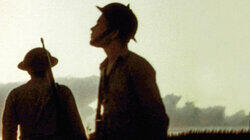
Months after the Pearl Harbor attack, shockwaves of war shake every corner of the Pacific, and young Americans deploy to stem the enemy advance. Culture clashes within the Allies erupt in Australia, but Allied forces later bond over efforts to thwart Japan's move to control New Guinea. Rare footage from military cameramen and other soldiers capture life behind the battle lines, showing there is more to the war than combat.
Island Hopping
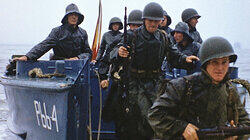
In the fall of 1943, the U.S. engages in a new series of island-hopping invasions, starting with the Gilbert and Marshall Islands and driving up through the Central Pacific. The first stop is the Tarawa atoll, where thousands of troops embark upon the largest amphibious invasion ever staged in the Pacific to fight one of the costliest battles of the war. Never-before-seen color footage from a captain in the U.S. Army Air Force shows airman camp life and low-level air attacks on Kavieng, New Guinea.
The Enemy Underground
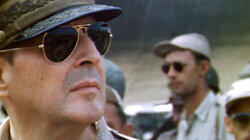
By summer of 1944, America is gaining the upper hand in the Pacific War with better training, troop numbers and supply lines, but the Japanese dig in and exact brutal tolls with each foothold. The U.S. aims for the heart of Japan's inner defense ring, engaging in a historic naval battle for Saipan in the Marianas. The nearly month-long battle on this island featured mountain sieges, Banzai attacks, white-knuckled dogfights, and escalating tensions between the U.S. Army and Marines. Color combat footage and testimony from the soldiers who were there bring this seminal moment of the Pacific War to life. America plans to rush into service the new top-secret, long-range Boeing B-29 bomber to strike directly at the mainland.
Striking Distance
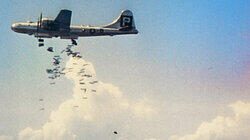
Allied forces move to take two valuable islands that threaten American air operations: Tinian and Guam. Taking back Guam, a U.S. territory with a Marine base before the war, is both personal and tactical to the Navy. Meanwhile, in India, rising star General Curtis LeMay is tasked with a top-secret assignment: fly over "The Hump" – the Himalayas – and bomb Japan. His own words and his personal footage, never broadcast before, show the desperate difficulty of the problems he faces.

Fire from the Sky
Allies slug it out on the nearby island of Peleliu in a long and bloody campaign to pave the way for General MacArthur's return to the Philippines. Never-before-broadcast footage shows troops enduring the muddy muck in the Philippines that bogs down the supply line. In the Battle of Leyte Gulf, an immensely fierce naval battle, Japan unveils a devastating new tactic: the kamikaze. Finally, General LeMay designs a radical raid on Japan, resulting in the deadliest single day of the war – the firebombing of Tokyo.
No Surrender
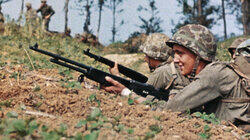
By the spring of 1945, America begins to take back the Philippines, Manila is liberated after a devastating battle, and the USO show comes to boost morale. On Borneo, the Australians invade Labuan and liberate the Indonesians from oppressive Japanese occupation. When the U.S. invades Okinawa, Japan makes a strong stand and launches the biggest kamikaze attacks of the war. Record-shattering casualties – including the generals from both sides – mount in island-hopping's last epic battle. POWs are rare. Japanese forces fight to the end, with no sign of surrender.

From the Ashes
President Harry Truman momentously decides to drop a new weapon – the atomic bomb – on Hiroshima and Nagasaki in August 1945. Emperor Hirohito surrenders, and General Douglas MacArthur arrives to oversee the country's occupation. Mortal enemies must now become partners in Japan's rebirth. In America, the internment camps are closed, but many Japanese-Americans have no homes to return to and fear reprisals. For survivors on both sides, the long journey home is the final exhausted act of the war.
Recently Updated Shows
True Detective
Touch darkness and darkness touches you back. True Detective centers on troubled cops and the investigations that drive them to the edge. Each season features a new cast and a new case.
True Detective is an American anthology crime drama television series created and written by Nic Pizzolatto.

The Grand Tour
Jeremy Clarkson, Richard Hammond and James May are back with The Grand Tour. A show about adventure, excitement and friendship... as long as you accept that the people you call friends are also the ones you find extremely annoying. Sometimes it's even a show about cars. Follow them on their global adventure.

Sugar
John Sugar is an American private investigator on the heels of the mysterious disappearance of Olivia Siegel, the beloved granddaughter of legendary Hollywood producer Jonathan Siegel. As Sugar tries to determine what happened to Olivia, he will also unearth Siegel family secrets; some very recent, others long-buried.

The Witcher
Based on the best-selling fantasy series, The Witcher is an epic tale of fate and family. Geralt of Rivia, a solitary monster hunter, struggles to find his place in a world where people often prove more wicked than beasts. But when destiny hurtles him toward a powerful sorceress, and a young princess with a dangerous secret, the three must learn to navigate the increasingly volatile Continent together.