The Sky at Night - Season 25 / Year 1981

The Sky at Night - Season 25 / Year 1981

Season 25 / Year 1981

Network
DatesJan. 11, 1981 - Dez. 13, 1981
Previous SeasonNext Season

Episodes

The 200-Inch Telescope At Mount Palomar
Year 1981Episode 130 min

The 200-Inch Telescope At Mount Palomar

Palomar Patrick Moore visits Mount Palomar in South California to see the great 200-inch telescope, and talks to the scientists who use the largest working telescope in the world.
Jan. 11, 1981
The Sword Of Orion
Year 1981Episode 230 min

The Sword Of Orion

The Orion nebula is one of the most famous objects in the sky. It is visible with the naked eye as a hazy patch in Orion's sword; small telescopes show it well, but we now know that it is only part of a vast mass of gas and dust in which fresh stars are being born, Inside it are some remarkable objects whose nature is still uncertain. One of the astronomers who is carrying out research into these fascinating mysteries is Dr John Beckman, who talks to Patrick Moore about the latest news from this 'stellar birthplace'.
Feb. 8, 1981
Mr Herschel's Planet
Year 1981Episode 330 min

Mr Herschel's Planet

Patrick Moore tells the story of William Herschel, the obscure Hanoverian army bandsman whose discovery with a home-made telescope of the planet Uranus doubled the size of the known solar system. Herschel was hired to provide 'astronomical entertainment' for the British Royal Family and King George III gave him £4,000 to build the world's largest telescope in a garden at Slough.
März 8, 1981
The Spring Sky
Year 1981Episode 430 min

The Spring Sky

What can be seen in the night sky this month? Patrick Moore describes the stars which are on view during April; he also shows the latest maps of Saturn's satellites drawn up from Voyager I pictures, and discusses the recent discovery of three galaxies so remote that their light takes about 10,000 million years to reach us.
Apr. 5, 1981
In The Beginning
Year 1981Episode 530 min

In The Beginning

In the crystal-clear atmosphere of La Palma in the Canary Islands the new Northern Hemisphere Observatory is being built. This observatory, a joint international project, is designed to study galaxies so remote that their light takes thousands of millions of years to reach us, leading us on to a real knowledge of the way in which the universe was born. One of the scientists involved is Professor F. Graham Smith , Director of the Royal Greenwich Observatory, who talks to Patrick Moore.
Mai 3, 1981
Neptune - The Mysterious Giant
Year 1981Episode 630 min

Neptune - The Mysterious Giant

Neptune, the outermost of the giant planets, has been known for well over a century, but our knowledge of it is still meagre. With its gaseous surface, its quick rotation and its large satellite, Triton, it is of tremendous interest. Patrick Moore and Dr Garry Hunt discuss what is known about Neptune and what future researches may tell us when Voyager 2 passes this ' outermost giant' in 1989.
Mai 31, 1981
Bombardment From Space
Year 1981Episode 730 min

Bombardment From Space

What are the chances of the Earth being hit by an asteroid - another and much smaller world orbiting the Sun? Just over 40 years ago the Earth was nearly in collision with an asteroid called Hermes. Statistically the danger of a collision is slight, but by no means nil. In America the NASA authorities have announced plans for destroying any approaching asteroid with a nuclear missile. Can we predict the possibility of a collision? In this programme Patrick Moore discusses the whole question of asteroid collisions with Dr David Hughes of Sheffield University.
Juni 28, 1981
The Summer Sky
Year 1981Episode 830 min

The Summer Sky

During summer evenings many interesting constellations are on view. There are also some spectacular double stars, most of them are binary systems in which the components are physically associated. Patrick Moore surveys the evening sky during the summer, and points out some double stars which may be seen with any small telescope.
Juli 26, 1981
The Perseids
Year 1981Episode 930 min

The Perseids

Meteors, or shooting stars, space debris shed by comets travelling round the sun, can produce brilliant displays and the Perseids, seen each year between 27 July and 17 August, are unusually spectacular. They are of special interest during the early 1980s, because the comet associated with them - Swift-Tuttle - is due back having been unobserved for 120 years. Patrick Moore talks to John Mason , who led an expedition to France to study the Perseids, and looks forward to the return of Halley's Comet, which also is associated with meteor showers.
Aug. 23, 1981
Voyager 2 - A Second Opinion Of Saturn
Year 1981Episode 1030 min

Voyager 2 - A Second Opinion Of Saturn

On 25 August the American spacecraft Voyager 2 made its pass of Saturn, and told us more about the unexpectedly complicated ring-system, the surface of the Planet, and the puzzling family Of satellites.
Sept. 20, 1981
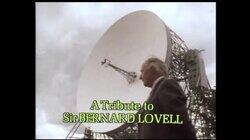
A Tribute to Sir Bernard Lovell
Year 1981Episode 1120 min

A Tribute to Sir Bernard Lovell

Tribute to Sir Bernard Lovell, recently retired as Director of the Radio Astronomy Observatory, Jodrell Bank. In this programme he talks to Patrick Moore about the radio telescope at Jodrell Bank.

Okt. 18, 1981
The Autumn Sky
Year 1981Episode 1230 min

The Autumn Sky

Pegasus, the flying horse, is the main autumn constellation - but do you know where to find it? Can you see Mars now - and if so. where is it? Where should one look for the Great Spiral in Andromeda, a huge system containing more than 100,000-milIion suns? Patrick Moore conducts a tour of the autumn sky.
Nov. 15, 1981
The Star Of Bethlehem
Year 1981Episode 1330 min

The Star Of Bethlehem

For almost 2,000 years, the Star of Bethlehem has been regarded as a major mystery. What was the Star of Bethlehem? Was it the planet Venus, an exploding star, a comet, or a grouping of planets? Patrick Moore examines all the latest evidence, and looks at the problem from the scientific point of view.
Dez. 13, 1981

Recently Updated Shows

Recently updated shows that might be of your interest.
Law & Order: Special Victims Unit
Running

Law & Order: Special Victims Unit

In the criminal justice system, sexually-based offenses are considered especially heinous. In New York City, the dedicated detectives who investigate these vicious felonies are members of an elite squad known as the Special Victims Unit. These are their stories.

FBI
Running

FBI

FBI is a fast-paced drama about the inner workings of the New York Field Office of the Federal Bureau of Investigation. These first-class agents, including Special Agent Maggie Bell and her partner, Special Agent Omar Adom 'OA' Zidan, bring all their talents, intellect and technical expertise on major cases in order to keep New York and the country safe.

GenreDrama, Crime
Tracker
Running

Tracker

Tracker features lone-wolf survivalist Colter Shaw, who roams the country as a "reward seeker," using his expert tracking skills to help private citizens and law enforcement to solve all manner of mysteries while contending with his own fractured family.

GenreDrama
NCIS
Running

NCIS

NCIS (Naval Criminal Investigative Service) is more than just an action drama. With liberal doses of humor, it's a show that focuses on the sometimes complex and always amusing dynamics of a team forced to work together in high-stress situations. Leroy Jethro Gibbs, a former Marine gunnery sergeant, whose skills as an investigator are unmatched, leads this troupe of colorful personalities. Rounding out the team are Anthony DiNozzo, an ex-homicide detective whose instincts in the field are unparalleled and whose quick wit and humorous take on life make him a team favorite; the youthful and energetic forensic specialist Abby Sciuto, a talented scientist whose sharp mind matches her Goth style and eclectic tastes; Caitlin Todd, an ex-Secret Service Agent; and Timothy McGee, an MIT graduate whose brilliance with computers far overshadows his insecurities in the field; Assisting the team is medical examiner Dr. Donald "Ducky" Mallard, who knows it all because he's seen it all, and he's not afraid to let you know. From murder and espionage to terrorism and stolen submarines, these special agents travel the globe to investigate all crimes with Navy or Marine Corps ties.

Highway Thru Hell
Running

Highway Thru Hell

Highway Thru Hell focuses on a team of drivers who work for Jamie Davis, along with several other heavy recovery operations fighting to keep the roads open in some of the most dangerous working conditions ever seen on TV. The Coquihalla and nearby highways through BC's Cascade Mountains have some of the most difficult and fast changing road conditions anywhere. When it's snowing hard up top on the summit of ‘The Coq', 1200 metres below its pounding rain in The Fraser Valley. Add to that, Canada's busiest trucking route to the West Coast, Highway 1 (Trans Canada Hwy), and you have the ‘Bermuda Triangle' of trucking. Police and highway maintenance crews depend on Highway Thru Hell's heavy rescue operators to respond at a moment's notice in the worst conditions. In between the winter storms, the teams ‘off road' skills are put to the test. The rugged terrain near Hope, British Columbia dishes out some of the most unique and challenging recovery jobs over steep cliffs, down deep ravines and even in bodies of water. Highway Thru Hell is ultimately a series about man versus Mother Nature and the toughest men in the towing business being pushed to their breaking point. The stakes are high - lives, the economy and thousands of jobs depend on the highways staying open, and the last line of defense is Heavy Rescue.