New Blood
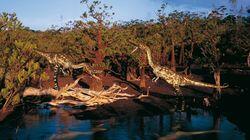
220 million years ago, Late Triassic (Arizona)Filming location: New Caledonia
A female Coelophysis is shown stalking a herd of dicynodonts called Placerias (a giant synapsid or mammal-like reptile), looking for weak members to prey upon. A male Thrinaxodon is shown downstream, returning to his burrow from the river. The last focus of the episode is a female rauisuchian Postosuchus (one of the largest carnivores alive in the Triassic) who is first shown attacking a Placeriasherd and bites one of the members, driving the rest of the herd to retreat and leave the wounded and weakened member of the group to the carnivore. Early pterosaurs called Peteinosaurus are depicted feeding on dragonflies and cooling themselves in what little water is present during the drought. Still searching for food, the Coelophysis are shown discovering the Thrinaxodon burrow (and are initially frightened away by the male when it emerges). Eventually, an inquisitive Thrinaxodon pup follows the father to the entrance and is eaten by the female Ceolophysis before he can drive the predator away. At night, the pair of Thrinaxodon are shown eating their remaining young, then moving away, while during the day, the Coelophysis work to expose the nest.
The female Postosuchus is later shown to have been wounded by the Placerias in a previous attack (which left her with a tusk wound on her thigh), and after being unable to successfully hunt another member of the Placerias herd she is beaten out of her territory by a rival male Postosuchus. Wounded, sick and without a territory, the female dies and is eaten by a pack of Coelophysis. As the dry season continues however, food becomes scarce and extreme measures are taken by all animals. The Placerias herd embarks on a trek through parched wasteland in search of water, while the Coelophysis start killing and cannibalising their young. The male Thrinaxodon also resorts to hunting baby Coelophysis during the night. Finally, the wet season comes, and the majority of theCoelophysis have survived (including the female), along with the Thrinaxodon pair, who have a new clutch of eggs. The episode ends with the arrival of a migrating herd of the prosauropod Plateosaurus, foreshadowing the future dominance of the giant sauropods after the Triassic-Jurassic extinction event.
Animals Coelophysis · Thrinaxodon (identified as Cynodont) · Placerias · Postosuchus · Peteinosaurus · Plateosaurus · Lungfish ·Dragonflies
Trailer
Recently Updated Shows

Baylen Out Loud
Baylen Out Loud Baylen Dupree, a vibrant and resilient 22-year-old with Tourette Syndrome. Every day, Baylen faces a variety of extreme and uncontrollable vocal and motor tics while navigating the challenges of becoming an independent adult. Supported by her loving family in West Virginia, including her five siblings, devoted boyfriend, Colin, protective father, Allen, and strong and independent mother, Julie, Baylen learns to manage the complexities of Tourette and embrace life fully.

Dark Matter
Hailed as one of the best sci-fi novels of the decade, Dark Matter is a story about the road not taken. The series follows Jason Dessen, a physicist, professor, and family man who – one night while walking home on the streets of Chicago – is abducted into an alternate version of his life. Wonder quickly turns to nightmare when he tries to return to his reality amid the multiverse of lives he could have lived. In this labyrinth of mind-bending realities, he embarks on a harrowing journey to get back to his true family and save them from the most terrifying, unbeatable foe imaginable: himself.


The Tonight Show Starring Jimmy Fallon
Emmy Award and Grammy Award winner Jimmy Fallon brought NBC's "The Tonight Show" back to its New York origins when he launched The Tonight Show Starring Jimmy Fallon from Rockefeller Center. Fallon puts his own stamp on the storied NBC late-night franchise with his unique comedic wit, on-point pop culture awareness, welcoming style and impeccable taste in music with the award-winning house band, The Roots.

Murdoch Mysteries
Set in Toronto at the dawn of the 20th century, Murdoch Mysteries is a one-hour drama series that explores the intriguing world of William Murdoch, a methodical and dashing detective who pioneers innovative forensic techniques to solve some of the city's most gruesome murders. Murdoch's colleagues include the love of his life, coroner and psychiatrist Dr. Julia Ogden, a staunch ally who shares the detective's fascination for science; Constable George Crabtree, Murdoch's eager but sometimes naïve right-hand man; Inspector Brackenreid, Murdoch's skeptical yet reluctantly supportive boss; and coroner Dr. Emily Grace, Dr. Ogden's protégé.