Ocean
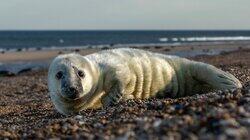
Sir David Attenborough explores the surprisingly vibrant seas that surround the British Isles. The vast watery wilderness around us is over three times the size of our land mass, and yet to many, our oceans remain a mystery. Full of colour and teeming with life, the seas of Britain and Ireland are crucially important to a range of wildlife. This episode goes beneath the waves to uncover the thriving habitats that exist along our 22,000-mile coastline.
In winter, clear evidence of the ocean's abundance can be seen on a beach in Norfolk. Thousands of grey seals congregate on the shoreline to give birth. Britain and Ireland are home to 40 per cent of the world's grey seals, and the number being born on our shore rises every year. Once the newly born pups are weaned, the females are ready to breed again, and heavyweight males enter violent, bloody fights to win a stretch of beach, and the females along with it.
Beyond the beach, the vibrant shallows contain several important habitats. Rich beds of seagrass are nurseries for a range of animals, while also acting as very important carbon storage areas. They are also home to one of the strangest fish in our waters, the seahorse. We follow a male and female as they perform a balletic mating dance in the water, delicately entwining their tails. The stakes are high, as these animals mate for life.
In deeper water, patterned cuttlefish prowl the water on the hunt for food. When night falls, tiny algae floating in the water alert the cuttlefish to nearby prey. The bioluminescence allows the cuttlefish to snatch their victims, even in the dead of night.
Some animals, like the spider crab, undergo a mass migration along the shallow seabed. For just a few days every year, thousands of crabs march together, forming a huge mass of bodies. Others, like the slow-moving royal flush sea slug, have a more mesmerising way of migrating. They use the water currents to carry them to new and food-rich areas, using their bodies like wings to swim upwards and drift.
At the most northerly point of the British Isles are the Shetland Islands. The undisturbed coastline here is a stronghold for more than a thousand otters. We follow a fearless young otter as it dives to the sea floor, turning up rocks in search of fish and crabs. They need to catch enough prey to keep warm in the frigid northern water. Thankfully, the pickings here are rich.
The Corryvreckan whirlpool off Scotland's west coast is the third-largest whirlpool on the planet. Clashing currents recycle nutrients up to the surface, and the waters become a rich soup of tiny floating algae that serve as food for a group of alien-looking animals called the zooplankton, which are in turn a crucial food for our largest fish, the basking shark.
Herring and mackerel form huge swirling shoals as they too feed on plankton, and this attracts the attention of aerial hunters. Gannets dive at speeds of more than 60 miles an hour to snap up the fish. As they hit the surface, they fold their wings back to avoid them breaking on impact.
In a touching piece to camera, Sir David bids a fledging Manx shearwater chick farewell as it embarks on a 6,000-mile journey across the oceans to South America. There is no better example of how important the British Isles and its abundant seas are to the survival of wildlife worldwide.
Trailer
Recently Updated Shows

President Curtis
President Curtis follows the Commander-in-Chief and his eccentric staff as they tackle the kind of crises that Rick Sanchez could never be bothered with - from interdimensional diplomacy to paranormal investigations and unexplained phenomena.

MobLand
With the most powerful clients in Europe, MobLand will see family fortunes and reputations at risk, odd alliances unfold, and betrayal around every corner; and while the family might be London's most elite fixers today, the nature of their business means there is no guarantee what's in store tomorrow.
MobLand follows two generations of gangsters, the businesses they run, the complex relationships they weave and the man they call upon to fix their problem.


Survivor
Eighteen to twenty castaways will compete against each other on Survivor. All castaways will compete to outwit, outplay, outlast and ultimately be crowned Sole Survivor.